
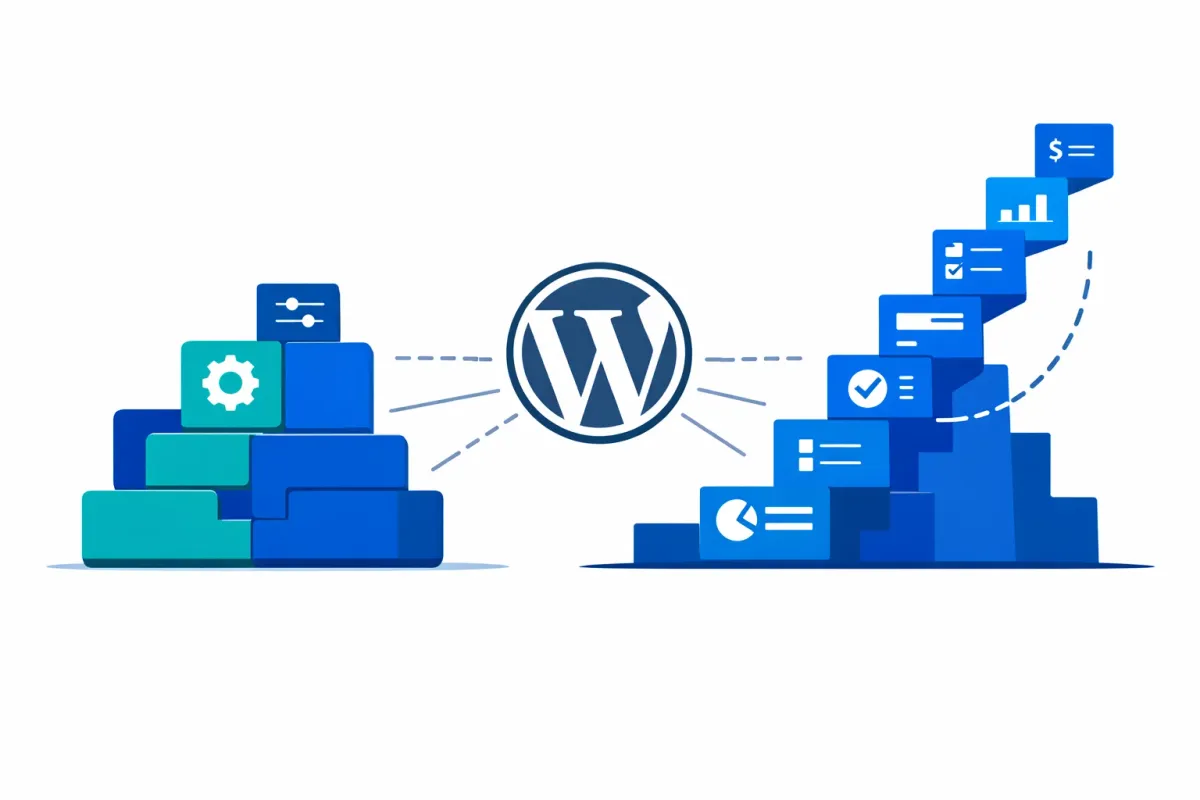
The Hidden Cost of SaaS Automation for WordPress Sites
Compare WordPress automation costs: self-hosted vs SaaS in 2026. TCO analysis across 3 scenarios shows agencies and enterprises save $50K-$200K+ over 3 years.
WordPress Automation Cost Analysis: Self-Hosted vs. SaaS Platforms (2026)
The cost comparison between self-hosted WordPress automation and SaaS platforms has become critical as subscription pricing escalates at nearly five times market inflation. The Vertice SaaS Inflation Index 2026 documents cost increases averaging over 12% annually while IT budgets grow at just 2.8%. WordPress-native tools have matured: Gravity Flow 3.0, WP Webhooks Pro, and AutomatorWP deliver flat-rate pricing with no per-task fees.
This article provides the first WordPress-specific TCO framework across three scenarios: solo site, agency, and enterprise.
Understanding the Three Pricing Models
Per-task pricing charges for each discrete action. A five-step workflow consumes five billable tasks per execution — the multiplier effect. At 100 multi-step executions monthly, this generates 500+ billable tasks.
Per-execution pricing charges once per workflow run regardless of step count. Mid-tier plans typically provide 50,000 executions monthly for $50-80.
Flat-rate self-hosted licensing eliminates usage-based fees. Gravity Flow charges $99-447 annually regardless of volume, executions, or users.
The divergence appears at scale. An agency processing 500 workflows across 25 sites faces $6,600-21,600 in SaaS costs versus $7,700-16,800 self-hosted — and that gap compounds at 12%+ annually.
The WordPress-Native Automation Toolkit
Self-hosted automation uses three components with flat annual licensing:
Workflow engines like Gravity Flow ($99-447/yr) handle multi-step processes and conditional routing. AutomatorWP ($149-499/yr) connects plugins through trigger-action pairs.
Integration hubs like WP Webhooks Pro ($79-299/yr) provide webhook endpoints and API connectivity.
Event schedulers like Action Scheduler (free, bundled with WooCommerce) manage background queues at 10,000+ operations hourly on properly configured hosting.
This stack requires automation-capable hosting: 512MB+ PHP memory, real server cron, and database maintenance. Providers charge $25-50 monthly versus $11-25 for basic hosting.
SaaS Cost Escalation: The Data
The Vertice SaaS Inflation Index 2026 documents structural pricing pressure:
- SaaS inflation reaching 12.2% by December 2025 (nearly 5x G7 rates)
- Costs per employee rising to $9,100 (from $7,900 in 2023)
- 50%+ of revenue growth from price increases for many public SaaS companies
- Credit-based pricing up 126% year-over-year
Growth Unhinged tracked 1,800+ pricing changes across 500 companies in 2025 (3.6 per vendor). Sixty percent mask increases through AI bundling or tier restructuring.
TCO Framework: Three Scenarios
Scenario 1: Solo Site Owner (50 executions/month)
| Component | Self-Hosted | SaaS |
|---|---|---|
| Platform license | $79-149 | $240-480 |
| Hosting | $300-600 | Included |
| Per-task overages | $0 | $0-600 |
| Year 1 | $379-749 | $240-1,080 |
| Year 2 | $379-758 | $264-1,128+ |
SaaS entry tiers appear cheaper initially, but per-task costs escalate unpredictably. Break-even favors self-hosted at 100+ multi-step executions monthly.
Scenario 2: Agency (10-25 sites, 500 executions/month)
| Component | Self-Hosted | SaaS |
|---|---|---|
| Licenses | $500-1,000 | $2,400-6,000 |
| Hosting | $1,200-3,600 | Included |
| Per-task fees | $0 | $4,200-15,600 |
| Maintenance | $6,000-12,000 | $0 |
| Year 1 | $7,700-16,600 | $6,600-21,600 |
| Year 2 | $7,700-16,800 | $7,392-24,192 |
Self-hosted shows advantage at scale: fixed licensing across unlimited sites versus per-task costs compounding with volume. Maintenance represents the largest self-hosted cost but covers broader site management.
Scenario 3: Enterprise (50+ sites, 5,000+ executions/month)
| Component | Self-Hosted | SaaS |
|---|---|---|
| Automation stack | $1,500-3,000 | $12,000-60,000 |
| Hosting | $6,000-24,000 | Included |
| Per-task credits | $0 | $12,000-60,000 |
| Developer retainer | $24,000-48,000 | $0 |
| Security/compliance | $3,000-6,000 | $9,000-36,000 |
| Year 1 | $34,500-81,000 | $33,000-156,000 |
| Year 3 Cumulative | $103,500-243,000 | $111,355-526,406 |
TCO divergence is most pronounced at enterprise scale. Self-hosted remains fixed; SaaS compounds at 12%+ annually. Three-year SaaS premium: $50,000-$200,000+ versus flat self-hosted baseline.
Hidden Costs on Both Sides
Self-hosted:
- Plugin compatibility testing after updates
- Security patch management (nearly 8,000 new WordPress vulnerabilities in 2024)
- Database maintenance (Action Scheduler tables: 10-20GB at high volume)
- Development resources (60-70% of total ownership per WP Engine data; note commercial bias)
SaaS:
- AI bundling (60% of platforms add 10-20% price increases for unused features)
- Credit opacity making consumption unpredictable
- Renewal leverage (83% of negotiations require 120+ day lead times)
- Data sovereignty premiums for EU compliance
- Platform lock-in and migration costs
Key distinction: self-hosted costs are variable but predictable through capacity planning. SaaS costs are predictable monthly but compound annually above IT budget growth rates.
The Data Sovereignty Factor
Regulatory requirements are now material TCO variables. The EU Data Act (effective September 12, 2025) extends sovereignty to non-personal and industrial data. GDPR enforcement: 2,500+ fines totaling EUR 6.7 billion+, with penalties reaching EUR 20 million or 4% of global turnover.
Self-hosted WordPress on EU infrastructure eliminates third-party data processing dependencies. The US CLOUD Act allows disclosure from American cloud providers regardless of data location — creating direct EU sovereignty conflict.
For regulated industries (financial services under DORA, healthcare, government contractors), data sovereignty overrides cost considerations.
Decision Framework
Choose self-hosted when:
- Volume exceeds 100 multi-step executions monthly
- Managing 10+ sites with shared patterns
- EU data sovereignty requirements apply
- Cost predictability matters more than entry price
- Technical capacity exists for maintenance and monitoring
Choose SaaS when:
- Volume under 50 simple executions monthly
- Managing 1-3 sites with minimal complexity
- Development resources constrained
- Operating in non-EU jurisdictions
- Vendor-managed security justifies premium
For agencies and enterprises, ask “which cost trajectory” not “which is cheaper today.” A $5,000 annual difference compounds to $15,000-$20,000+ by Year 3.
Conclusion
WordPress automation delivers documented ROI — Gravity Flow case studies show loan closing turnaround reduced from 30 to 14 days. Platform choice determines whether savings remain in your organization or flow to vendors through escalating subscriptions.
Self-hosted requires technical investment: hosting optimization, plugin configuration, security maintenance. In exchange: flat annual costs, unlimited execution capacity, complete data sovereignty.
SaaS offers immediate deployment with managed infrastructure. Trade-offs: compounding costs at 12%+ annually, per-task pricing penalizing success, data processing dependencies conflicting with regulatory requirements.
For WordPress site owners in 2026, total cost of ownership extends beyond Year 1 pricing. It encompasses three-year trajectories, regulatory compliance, and long-term sustainability of automation economics as operations scale.
Pricing Disclaimer: All pricing data current as of February 2026. Verify vendor pricing and hosting costs directly before making purchase decisions. SaaS inflation projections use documented industry averages; actual vendor pricing may vary.
Currency Note: All dollar amounts in USD. EUR amounts preserved for regulatory fine totals.